
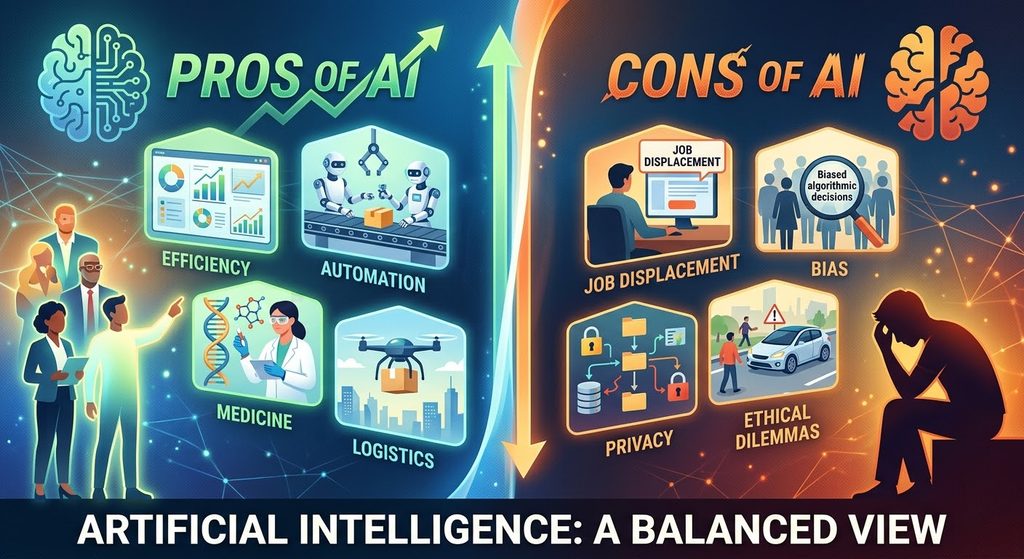
Artificial intelligence is becoming the fundamental force behind the contemporary global economy, not just a futuristic invention fit for science fiction. AI has permeated almost every industry, from machine learning models speeding up tailored treatment to autonomous workflow agents overseeing corporate pipelines.However, the distinction between unquestionable advantage and unanticipated risk becomes more hazy as AI moves from passive helper tools to completely autonomous, decision-making systems. Business executives, employees, and regular consumers must all comprehend the practical benefits and drawbacks of artificial intelligence.
The Pros of Artificial Intelligence
1.Unprecedented Operational Efficiency
AI systems never get tired, take sick days, or experience physical burnout. Millions of high-volume data points can be processed in seconds by automated algorithms, which streamlines digital workflows, logistics management, and customer service continuously.
2.Drastic Reduction in Human Error
Properly calibrated machine learning models perform tasks with consistent precision in situations where human focus naturally varies over time. AI lowers the possibility of expensive human errors in fields including data processing, financial auditing, and medical diagnosis.
3.Accelerated Innovation in Healthcare and Science
Predictive models powered by AI examine intricate biological and medical data at previously unthinkable rates. Researchers can now find new drugs, identify diseases in their early stages, and create individualized treatment programs for patients thanks to this increase in skills.
4.Taking On Hazardous Tasks
Deploying AI-powered robotics in dangerous settings—such as deep-sea exploration, hazardous waste handling, or structural inspections—allows dangerous operations to be completed safely, saving human lives.
The Cons of Artificial Intelligence
1.Workforce Shifts and the Skills Gap
Traditional entry-level jobs are under increasing market pressure as autonomous AI agents replace entry-level administrative, analytical, and coding activities. Although new specialized sectors are created by technology, workers who do not have instant access to digital reskilling may be displaced due to the quick changeover.
2.Absence of Emotional Intelligence and Moral Context
AI is capable of processing logic, patterns, and historical facts, but it is devoid of ethical intuition, human sensitivity, and true empathy. A human touch is still necessary in high-stakes situations that call for careful interpersonal care, creative direction, or value-driven leadership.
3.Privacy, Bias, and Algorithmic Hallucinations
The impartiality of AI algorithms depends on the quality of the training data. Unfair hiring, lending, or law enforcement outcomes can result from biased training data. Furthermore, if left unchecked, model “hallucinations”—which produce facts that sound convincing but are false—pose systemic hazards.
4.Substantial Setup and Energy Costs
Building, fine-tuning, and hosting proprietary AI architecture requires significant financial investment in computing platforms, data center capacity, and expert talent. These costs often create a competitive barrier for smaller businesses.
AI at a Glance: Key Trade-Offs
| Advantage (Pro) | Related Challenge (Con) |
| 24/7 Productivity & Speed | Potential displacement of repetitive human jobs |
| High Precision Data Processing | Vulnerability to biased or inaccurate data inputs |
| Accelerated R&D and Diagnostics | Loss of human-centric empathy and contextual judgement |
| Hazardous Task Automation | High infrastructure, hardware, and compute costs |
Conclusion
Artificial intelligence is a potent force multiplier rather than an all-powerful remedy or an impending threat to the labor force. The way humanity creates, controls, and uses it will determine its final worth.Organizations can harness the enormous productivity and creative benefits of AI while preserving human agency, privacy, and job prospects by establishing strong ethical governance, requiring open audit trails, and keeping human judgment directly in the loop. Going forward, the objective is to combine the extraordinary speed of machines with the vision, ethics, and empathy of the human mind rather than replacing human cognition with artificial reasoning.