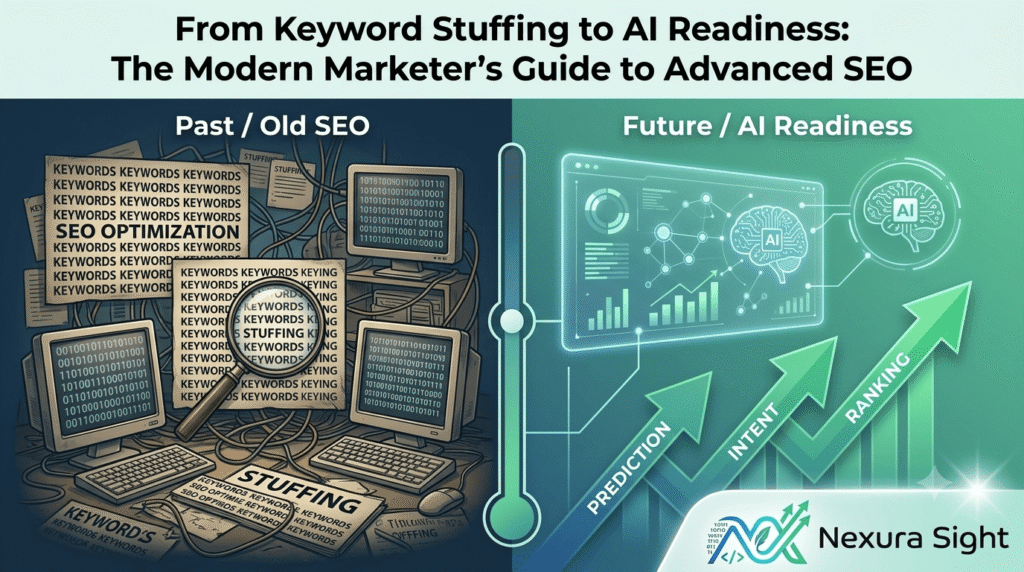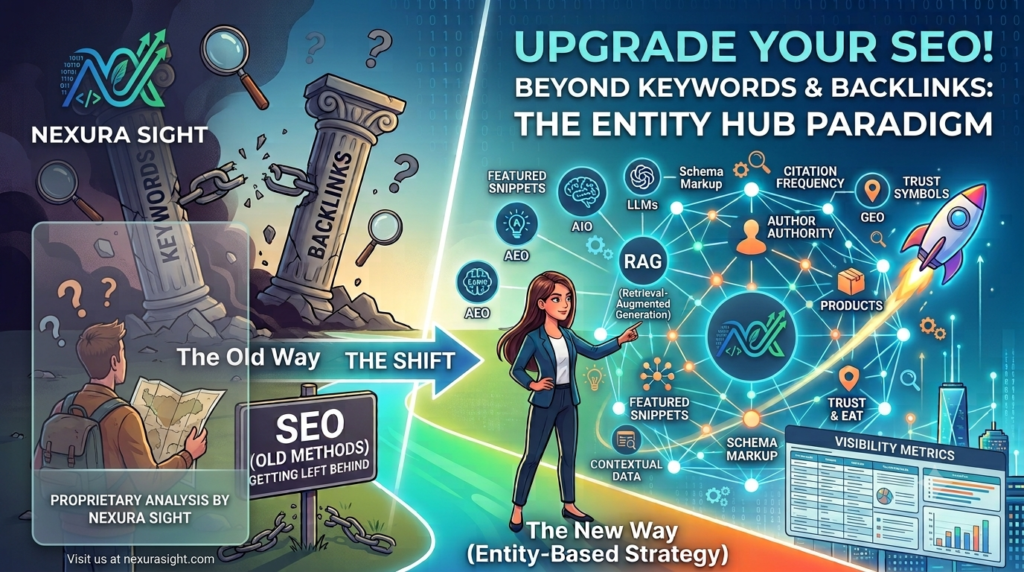

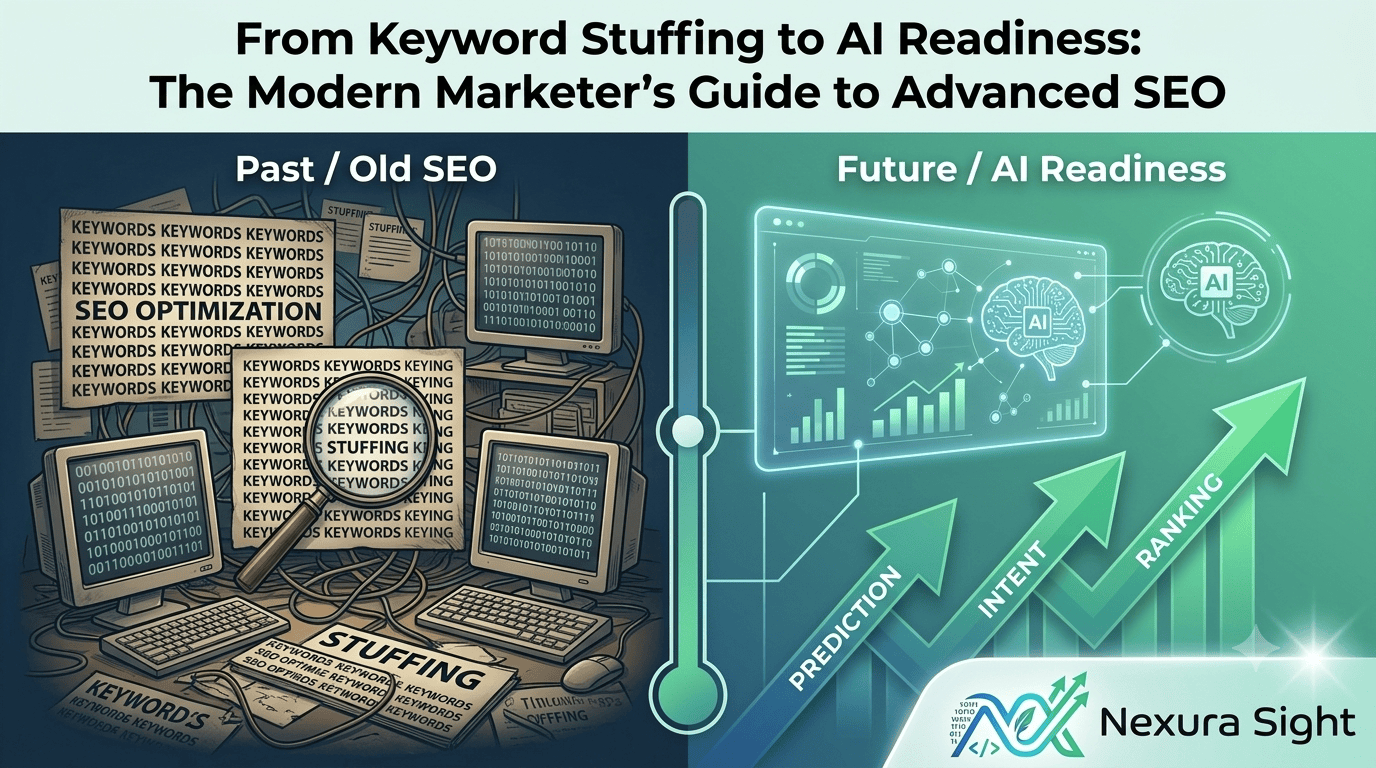
The digital ecosystem is undergoing its most radical transformation since the dawn of the internet. For over two decades, search marketing operated on a mechanical formula: find a popular phrase, apply strategic keyword stuffing across heading tags and paragraphs, secure a baseline of high-authority backlinks, and wait for rankings to rise. Today, that legacy playbook is entirely obsolete.
We have entered an era that moves far beyond static indexes of blue links. Survival in the modern market demands an Entity-based SEO Strategy that optimizes for an interconnected network of generative artificial intelligence, neural networks, and semantic retrieval engines. If your marketing framework remains dependent on exact-phrase matching and traditional keyword calculations, your brand is rapidly becoming invisible to consumers. To sustain growth, digital content creators must immediately transition from old-school keyword stuffing to an aggressive state of algorithmic AI readiness.
Table of Contents
Toggle1. The Core Shift: From Character Strings to Semantic Entities
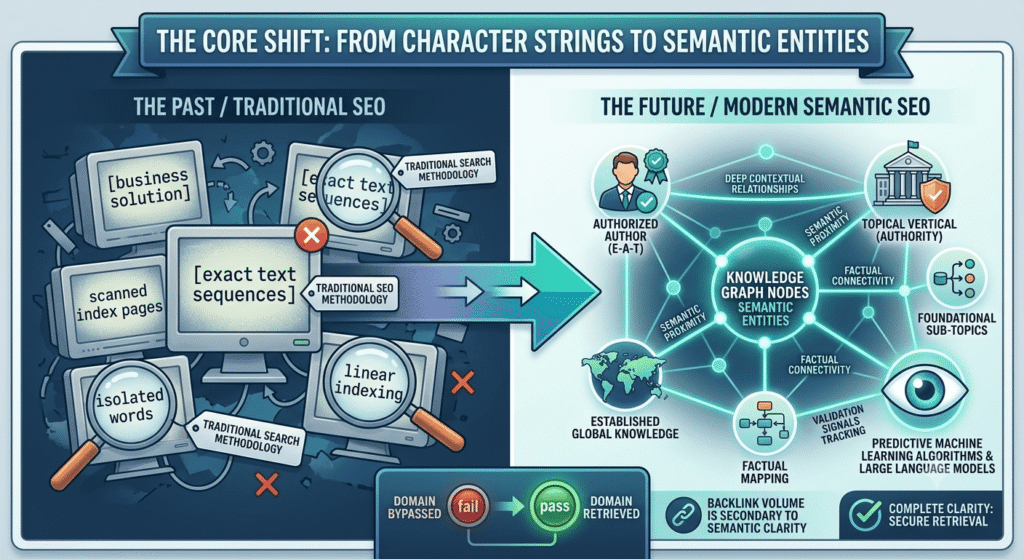
Traditional search optimization viewed digital content merely as a series of character strings. If a user searched for a specific business solution, the engine scanned its index for pages containing those exact text sequences. Modern search networks do not read words as isolated text; instead, they analyze your data as deeply contextualized entities and the relational edges that connect them.
An entity is a clearly defined, singular, and mathematically identifiable concept, person, place, brand, or object. Entities serve as the primary nodes within a search platform’s massive, multi-dimensional Knowledge Graph. When predictive machine learning algorithms or sophisticated large language models evaluate your website, they analyze your copy using metrics like semantic proximity and factual mapping.
The system is constantly tracking specific validation signals: Who is the verified author creating this asset? What real-world authority do they hold within this topical vertical? What foundational sub-topics are actively being unpacked on this page? How do these internal concepts align with the established web-wide knowledge graph? If an information retrieval model cannot place your content into its global knowledge structure with complete clarity, your domain will be bypassed during the retrieval stage—regardless of your backlink volume.
2. Navigating the Architecture of AI Overviews (AIO)
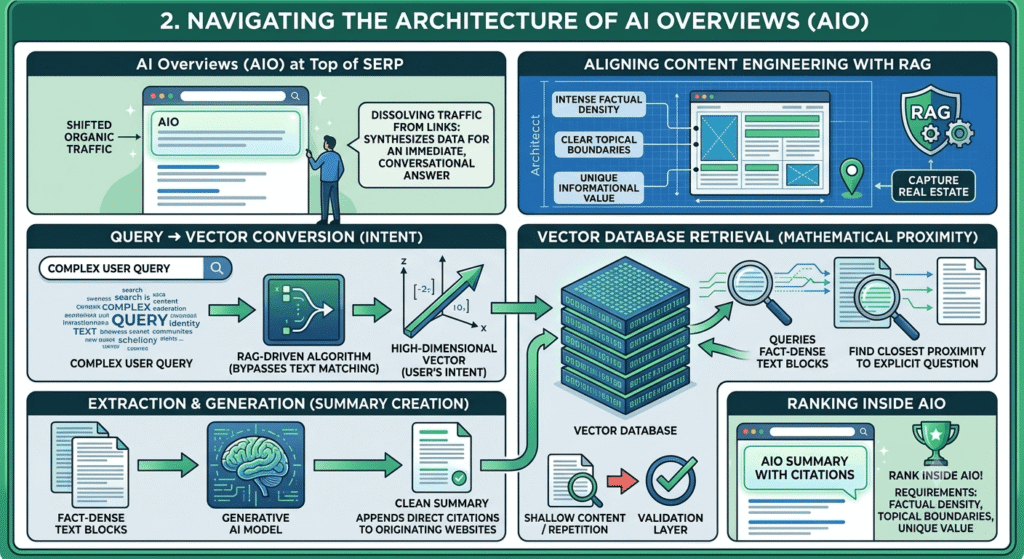
The integration of AI Overviews (AIO) at the absolute top of search engine results pages has permanently shifted how organic web traffic operates. These dynamic summary blocks do not just list external website links; they actively synthesize complex data from multiple web pages into an immediate, conversational answer directly on the user’s screen. To capture sustainable real estate inside AI Overviews, your content engineering must align with Retrieval-Augmented Generation (RAG) models.
When a user inputs a complex query, a RAG-driven algorithm bypasses standard text matching. Instead, the user’s intent is converted into a high-dimensional vector. The system then queries its internal vector database to instantly pull out fact-dense text blocks that display the closest mathematical proximity to the user’s explicit question.
Once these specific text blocks are extracted, the generative model refines them into a clean summary and appends direct citations to the originating websites. If your landing pages consist of shallow commentary or repetitive text, they fail the initial vector database validation layer. To rank inside AIO, your writing must exhibit intense factual density, clear topical boundaries, and unique informational value that an AI engine can effortlessly extract and synthesize.
3. Mastering Generative Engine Optimization (GEO)
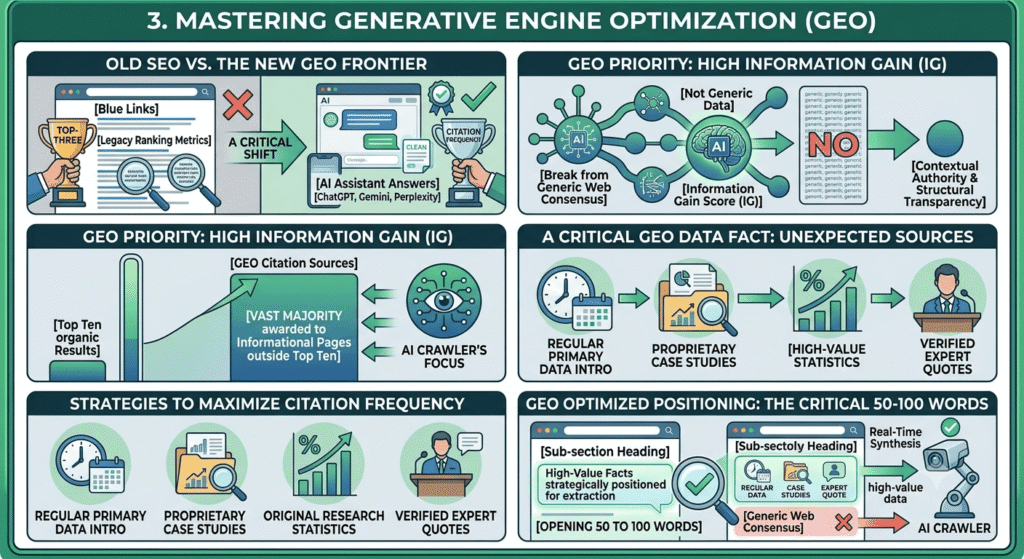
While old-school search marketing focuses on winning a top-three spot on a traditional blue-link SERP, Generative Engine Optimization (GEO) focuses entirely on maximizing your website’s citation frequency within AI assistant answers, such as OpenAI’s ChatGPT, Google Gemini, and Perplexity. Modern search data indicates a critical shift: a vast majority of source citations within generative AI answers are awarded to informational pages that do not even appear in the top ten results of traditional organic search.
Generative models value structural transparency and contextual authority far more than legacy ranking metrics. To systematically scale your GEO performance, your digital content must prioritize high information gain scores. This means your text must break away from the generic web consensus. AI engines are already trained on massive, repetitive datasets; they do not need your content to simply repeat common knowledge.
To maximize your citation frequency, you must regularly introduce primary data, proprietary case studies, original research statistics, and verified expert quotes. Furthermore, these high-value facts must be strategically positioned within the primary context window of the page—specifically within the opening 50 to 100 words of a given sub-section. This ensures the data remains fully intact when an AI crawler extracts your text blocks for real-time answer synthesis.
4. Dominating the Zero-Click SERP with Answer Engine Optimization (AEO)
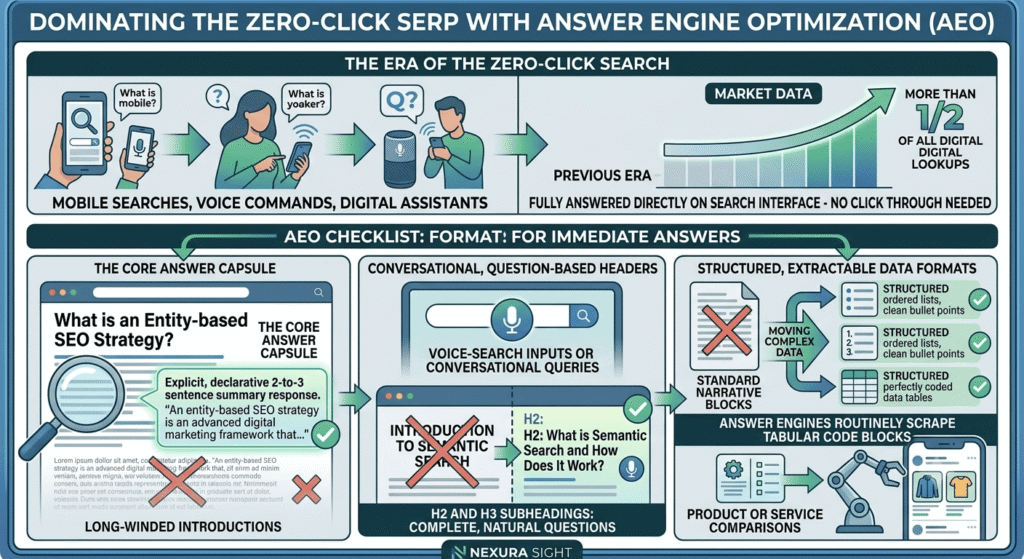
The explosive growth of mobile searches, conversational voice commands, and digital assistants has brought about the definitive era of the zero-click search. Current market data reveals that more than half of all modern digital lookups are fully answered directly on the search interface, meaning users have no need to click through to an external website. Surviving this zero-click environment requires a strict commitment to an Answer Engine Optimization checklist.
AEO is the technical practice of formatting your digital assets so they serve as the immediate, definitive answer for automated systems. To turn your website into a prime destination for modern answer engines, you must discard long-winded introductions and adopt a strictly structured layout:
-
The Core Answer Capsule: Every primary informational section must lead directly with an explicit, declarative 2-to-3 sentence summary response. Avoid vague descriptions. Use direct, authoritative sentence patterns (e.g., “An entity-based SEO strategy is an advanced digital marketing framework that…” instead of “When thinking about how search works today, it is helpful to explore…”).
-
Conversational, Question-Based Headers: Ensure your H2 and H3 subheadings are written as complete, natural questions that perfectly match the voice-search inputs or conversational queries typed by your audience.
-
Structured, Extractable Data Formats: Move complex comparison data away from standard narrative blocks and place them into structured ordered lists, clean bullet points, and perfectly coded data tables. Answer engines routinely scrape tabular code blocks to show side-by-side product or service comparisons directly in user search feeds.
5. Comparison: Legacy Keyword SEO vs. Advanced AI-Ready Strategy
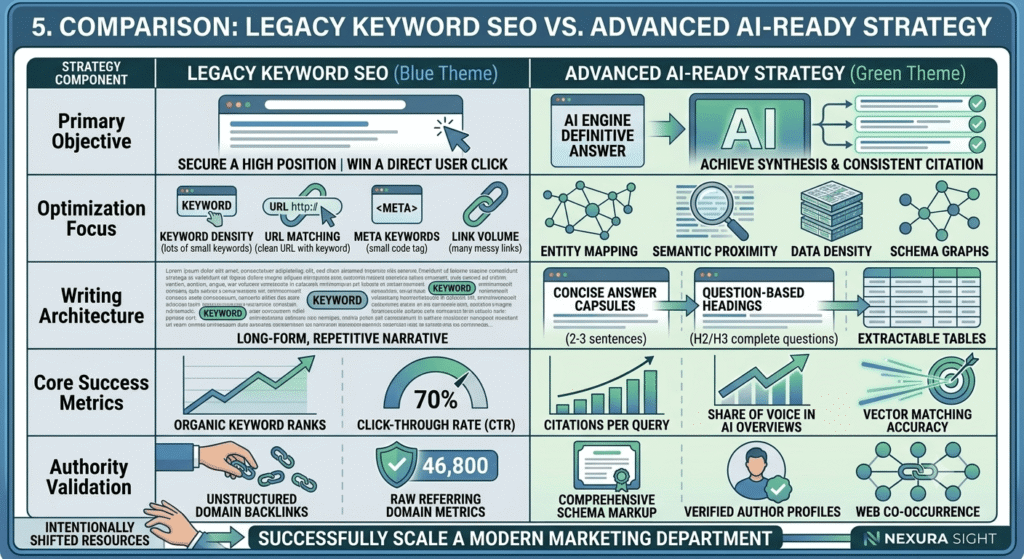
To successfully scale a modern marketing department, resources must be intentionally shifted away from outdated metrics and channeled directly into advanced, algorithmic optimization fields.
| Strategy Component | Legacy Keyword-Centric SEO | Advanced AI-Ready Strategy (AIO / GEO / AEO) |
| Primary Objective | Secure a high position in a list of blue links to win a direct user click. | Achieve synthesis and consistent citation as the definitive answer across AI engines. |
| Optimization Focus | Keyword density, URL matching, meta keyword placement, and link volume. | Entity mapping, semantic proximity, data density, and schema graphs. |
| Writing Architecture | Long-form, highly repetitive narrative text built around keyword targets. | Concise Answer Capsules, question-based headings, and extractable tables. |
| Core Success Metrics | Traditional organic keyword ranks and sitewide Click-Through Rate (CTR). | Citations per query, Share of Voice in AI Overviews, and vector matching accuracy. |
| Authority Validation | Unstructured domain backlinks and raw referring domain metrics. | Comprehensive schema markup, verified author profiles, and web co-occurrence. |
6. Technical Execution: Schema Graphs and Information Value
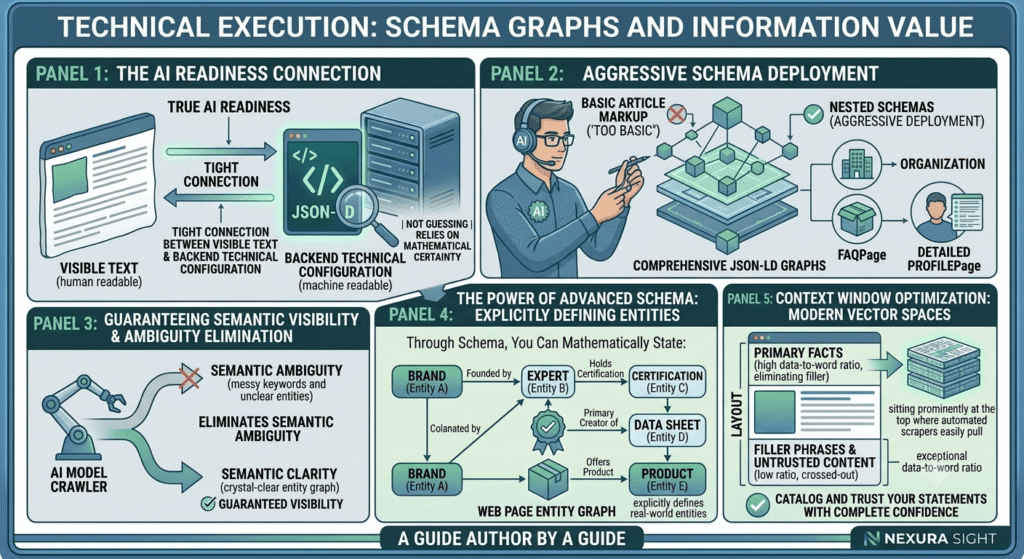
True AI readiness requires a tight connection between your visible text and your backend technical configuration. AI models do not guess your identity; they rely on mathematical certainty. The most powerful tool at your disposal to eliminate semantic ambiguity and guarantee visibility is the aggressive deployment of advanced Schema markup integration.
Your engineering team must implement comprehensive JSON-LD graphs that move far beyond basic article markup. Every asset must be supported by nested Organization, Product, FAQPage, and deeply detailed ProfilePage schemas. This technical layer allows you to explicitly define the real-world entities connected to your business.
Through schema, you can mathematically state: Our Brand (Entity A) is founded by an Expert (Entity B), who holds a specific Certification (Entity C), and is the primary creator of this Data Sheet (Entity D). When an AI crawler interacts with a web page backed by a crystal-clear entity graph, its retrieval-augmented models can catalog and trust your statements with complete confidence.
Furthermore, you must combine this structural clarity with strict context window optimization. Ensure that every sub-topic maintains an exceptionally high data-to-word ratio, eliminating filler phrases so that your primary facts sit prominently at the top of your layout where automated scrapers can easily pull them into modern vector spaces.
7. Action Plan for Modern Content Creators
To implement this advanced guide immediately and protect your website from becoming completely obsolete in AI-driven search models, execute these three non-negotiable operational steps:
-
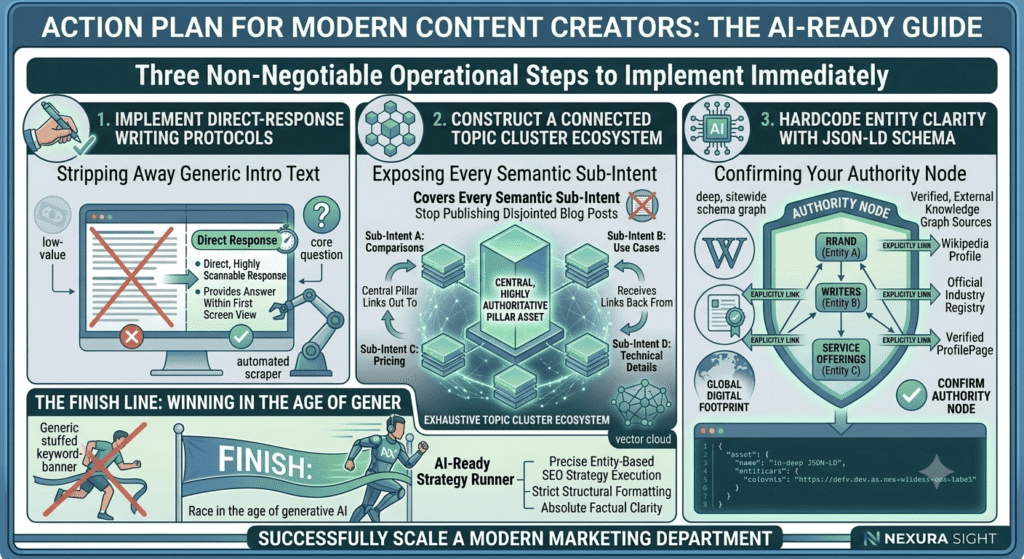
Implement Direct-Response Writing Protocols: Review your existing content library and systematically strip away low-value, generic introductory text. Ensure that every single informational landing page provides a direct, highly scannable response to the user’s core question within the first screen view.
-
Construct a Connected Topic Cluster Ecosystem: Stop publishing disjointed, individual blog posts based on isolated high-volume keywords. Instead, construct exhaustive topic clusters where a central, highly authoritative pillar asset links out to—and receives links back from—hyper-targeted sub-pages that cover every semantic sub-intent of the broader topic.
-
Hardcode Entity Clarity with JSON-LD Schema: Work directly with your development team to deploy deep, sitewide schema graphs. Explicitly link your brand, your writers, and your service offerings to verified, external knowledge graph sources (such as Wikipedia or official industry registries) to confirm your authority node across the global digital footprint.
Keywords remain a valuable tool for understanding human search intent at the starting line of content creation. However, precise entity-based SEO strategy execution, strict structural formatting, and absolute factual clarity are what will ultimately cross the finish line and win the race in the unstoppable age of generative AI search.
Keywords remain a valuable tool for understanding human search intent at the starting line of content creation. However, precise entity-based SEO strategy execution, strict structural formatting, and absolute factual clarity are what will ultimately cross the finish line and win the race in the unstoppable age of generative AI search.
Conclusion: Embracing the Future of Search
The transition from legacy keyword-centric tactics to an AI-ready framework is no longer optional; it is a fundamental requirement for digital survival. As the search landscape shifts toward entity-based mapping, generative summaries, and zero-click interfaces, brands must move beyond outdated metrics like link volume and keyword density.
To thrive in this new era, marketers must prioritize:
-
Semantic Authority: Building trust through clear entity definitions and comprehensive schema markup.
-
Structural Efficiency: Engineering content for RAG models through concise answer capsules, question-based headers, and high information gain scores.
-
Data-Driven Precision: Moving away from generic narrative text toward primary data, original research, and proprietary insights that provide unique value to AI engines.
While keywords remain useful for understanding initial user intent, they are merely the starting point. True competitive advantage in the age of generative AI is won through precise entity-based strategies, strict structural formatting, and an unwavering commitment to factual clarity. By executing these operational shifts today, you ensure your brand remains visible, relevant, and authoritative in an increasingly automated search ecosystem.