Top Computational Chemistry Tools Transforming Modern Research
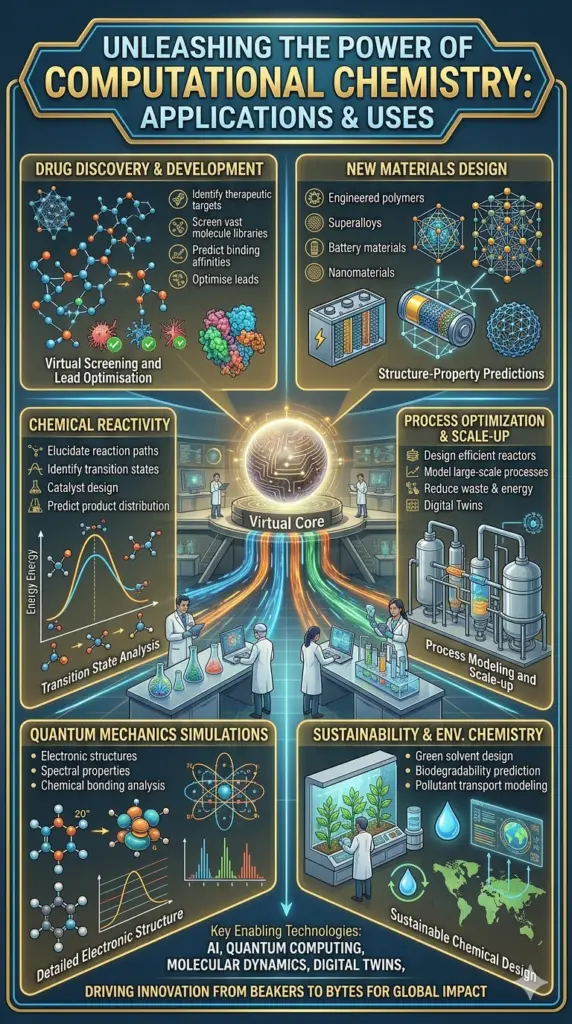
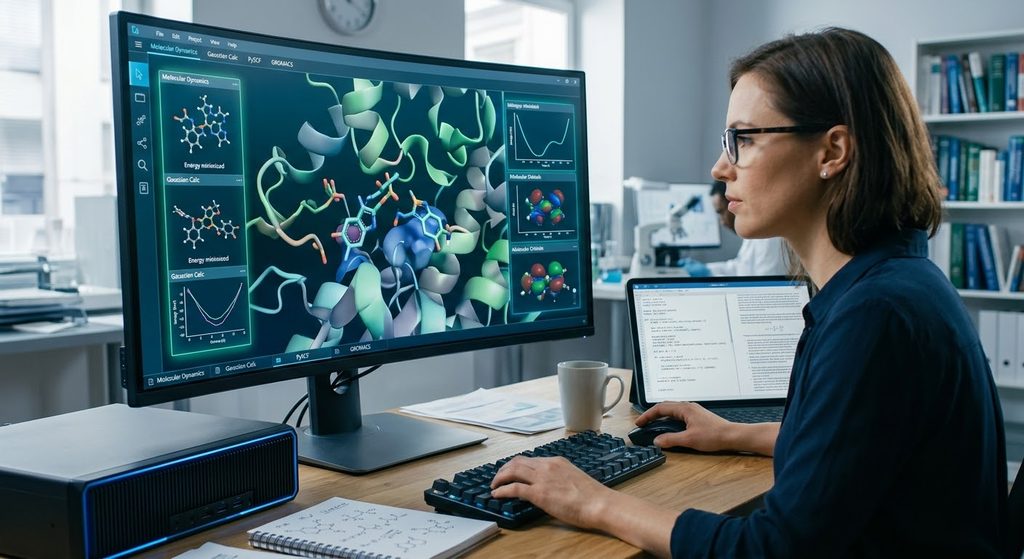
Computational chemistry has evolved from a specialized academic field to an essential component of contemporary scientific advancement. Researchers can save thousands of laboratory hours by using computational methods to analyze protein-ligand interactions, forecast chemical events, or build next-generation materials.Your research process can be accelerated by knowing which quantum chemistry program or molecular modeling software best suits your particular workflow. An outline of the most popular commercial and open-source computational chemistry tools used in labs today is provided below.
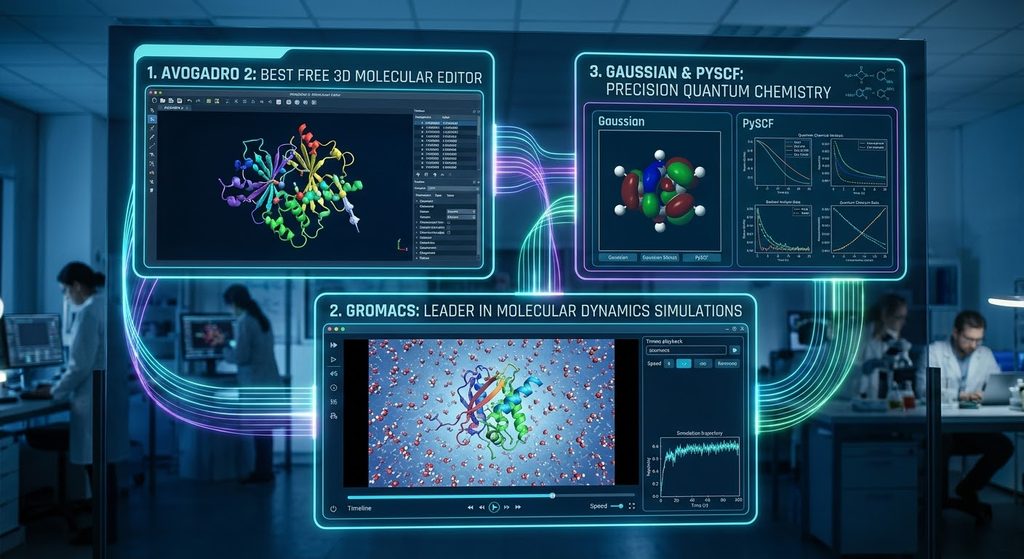
1.Avogadro 2: Best Free 3D Molecular Editor
Avogadro 2 is an exceptional open-source 3D molecular editor and visualizer for researchers, educators, and students seeking an approachable starting point.Key advantages include publication-quality rendering, an easy-to-use graphical user interface (GUI), and cross-platform compatibility (Windows, macOS, and Linux).
Best Used For: Building complex 3D molecular structures, preparing input files for quantum chemistry engines, and analyzing basic molecular orbitals.
[ Build/Edit Structure ] ──► [ Generate Input File ] ──► [ Run Quantum Engine ] (Avogadro 2) (SMILES/PDB) (Gaussian / PySCF)
2.GROMACS: Leader in Molecular Dynamics Simulations
GROMACS (Groningen Machine for Chemical Simulations) continues to be the high-performance standard for researching biological macromolecules such as proteins, lipids, and nucleic acids.Key advantages include unparalleled throughput for large-scale molecular dynamics simulations, GPU acceleration, and extreme algorithmic optimization.
Ideal For: Modeling membrane permeability, drug-target binding kinetics, and protein folding at microsecond timeframes.
3.Gaussian & PySCF: Precision Quantum Chemistry
Electronic structure techniques that solve the Schrödinger equation for molecular systems are necessary for quantum chemistry computations.Gaussian: The industry-standard commercial platform for vibrational spectrum prediction, ab initio computations, and density functional theory (DFT).PySCF is a quickly expanding open-source Python-based quantum chemistry framework that can be easily integrated with machine learning workflows and used for high-throughput electronic structure calculations.
4.Comparing the Leading Platforms
| Tool | Type | Core Specialty |
| Avogadro 2 | Open-Source | 3D Visualization & Editing |
| Gaussian | Commercial | Electronic Structure & DFT Calculations |
| GROMACS | Open-Source | Biomolecular Dynamics Simulations |
| PySCF | Open-Source | Pythonic Electronic Structure & AI/ML Integration |
Conclusion: The Future of Computational Chemistry
Scientific research has been completely changed by the incorporation of computational chemistry tools, from high-throughput platforms like GROMACS, Gaussian, and PySCF to user-friendly visualizers like Avogadro 2. These systems allow researchers to screen molecules, simulate dynamic mechanics, and assess electronic structures at a fraction of the time and expense needed for conventional laboratory tests by connecting theoretical models with empirical confirmation.
Understanding these digital tools is now crucial for advancing innovation in material science, green chemistry, and pharmaceutical discovery as research processes increasingly combine molecular dynamics with machine learning and automated pipelines.We are entering an era where the distinction between “computer scientist” and “chemist” is blurring.
As supercomputers become more powerful and algorithms more refined, our ability to engineer matter will only grow.The beaker will always have its place, but the future of chemistry is being written in code. By merging the physical and the digital, we are unlocking a faster, cleaner, and more innovative world.
- Selecting the Right Software for Your Workflow
Choosing a tool depends heavily on your computational goals:
- For Structure Preparation & Visualization: Start with Avogadro 2 to sketch ligands and generate clean coordinates.
- For Reaction Pathways & Orbital Energy: Implement electronic structure packages like Gaussian or PySCF.
- For Conformational Sampling & Time-Dependent Dynamics: Deploy GROMACS across dedicated GPU clusters.