
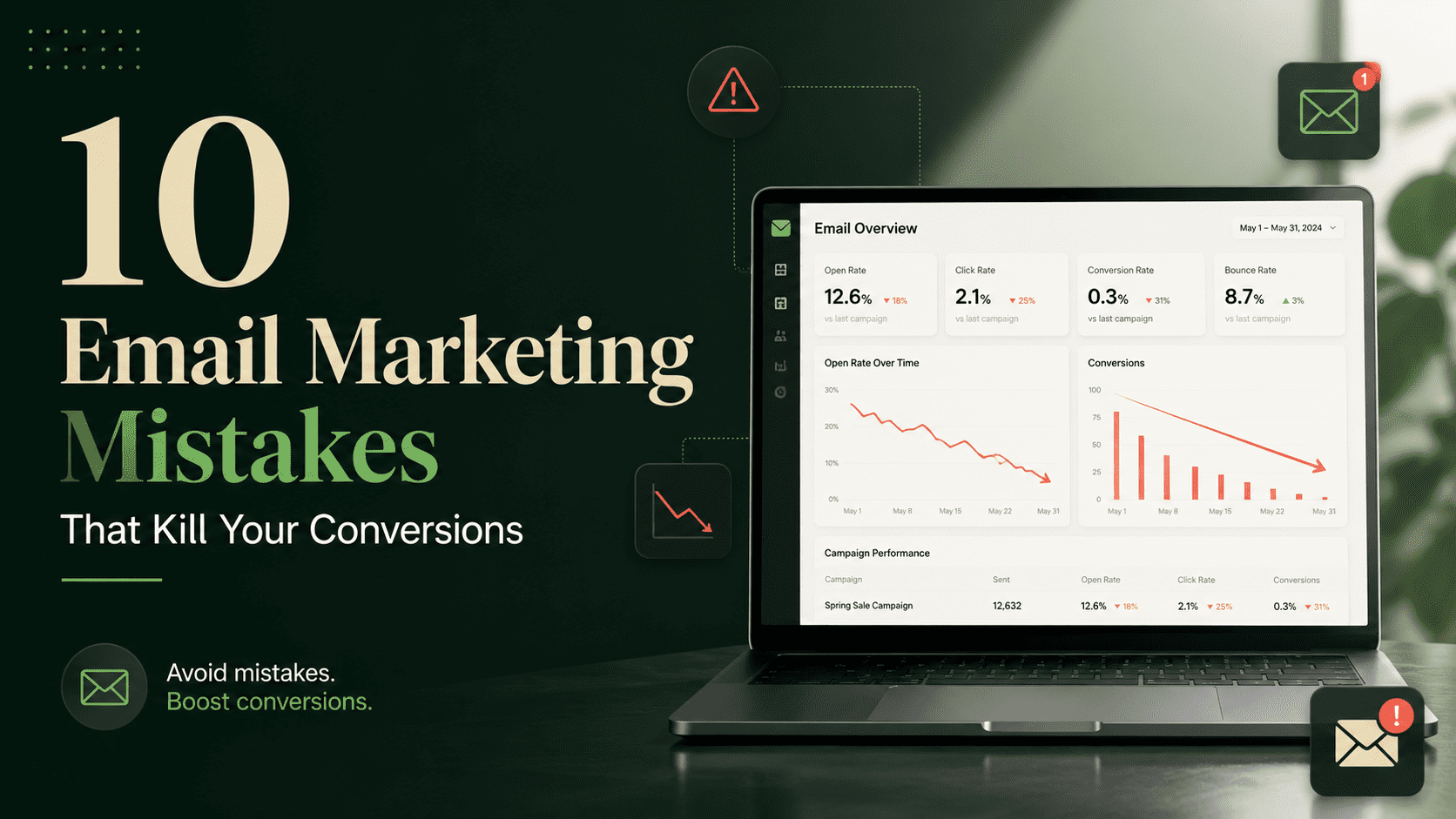
A practical guide for marketers, business owners, and entrepreneurs who want to stop losing money in their inbox and start turning emails into revenue. a comprehensive guide to avoid Email Marketing Mistakes
Table of Contents
ToggleIntroduction: Your email list is gold—are you treating it that way?
Here’s a sobering stat: for every $1 spent on email marketing, businesses earn an average return of $36. That makes email one of the highest-ROI marketing channels in existence. And yet, most businesses are quietly sabotaging their own campaigns every single day. If your open rates are low, your click-through rates are flat, or your subscribers are unsubscribing faster than they’re joining, you’re likely making one (or more) of the mistakes in this guide. The good news? Every single mistake is fixable. In the next few minutes, you’ll learn exactly what’s going wrong in your email campaigns, why it’s costing you conversions, and the practical steps you can take today to turn things around.
Let’s get into it.
$36 Return per $1 spent on email marketing
26% Higher open rates with personalized subject lines
81% Consumers check email on mobile devices
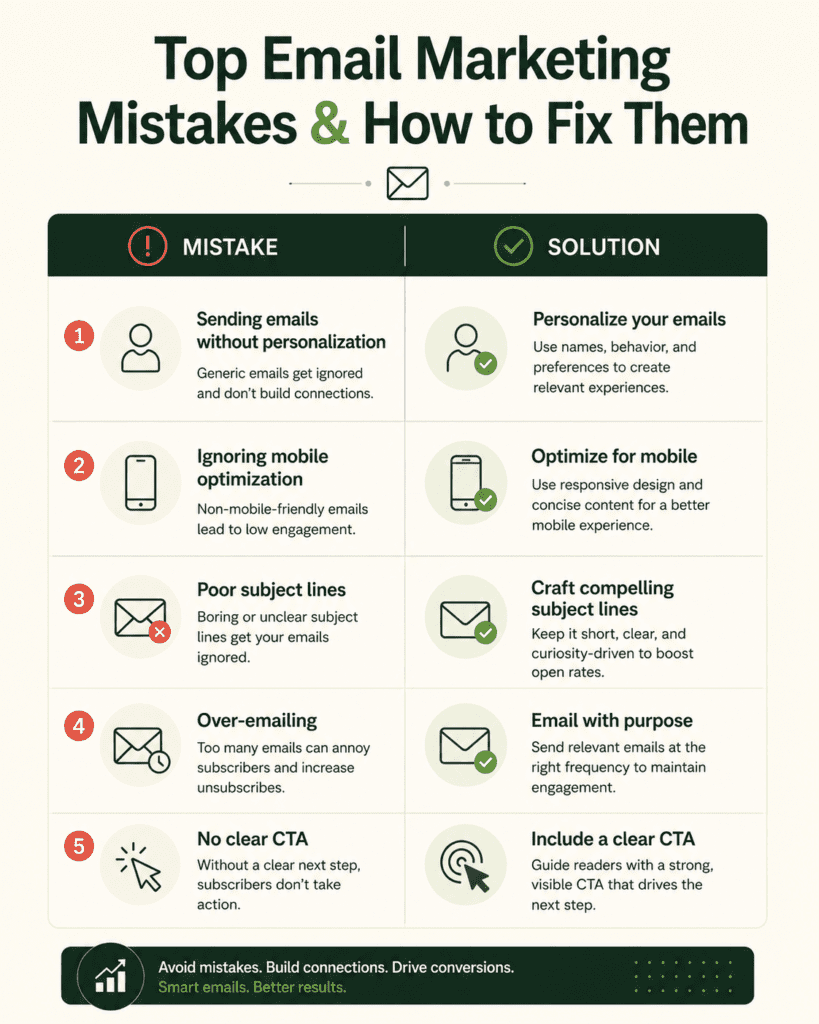
1. Sending emails without personalization
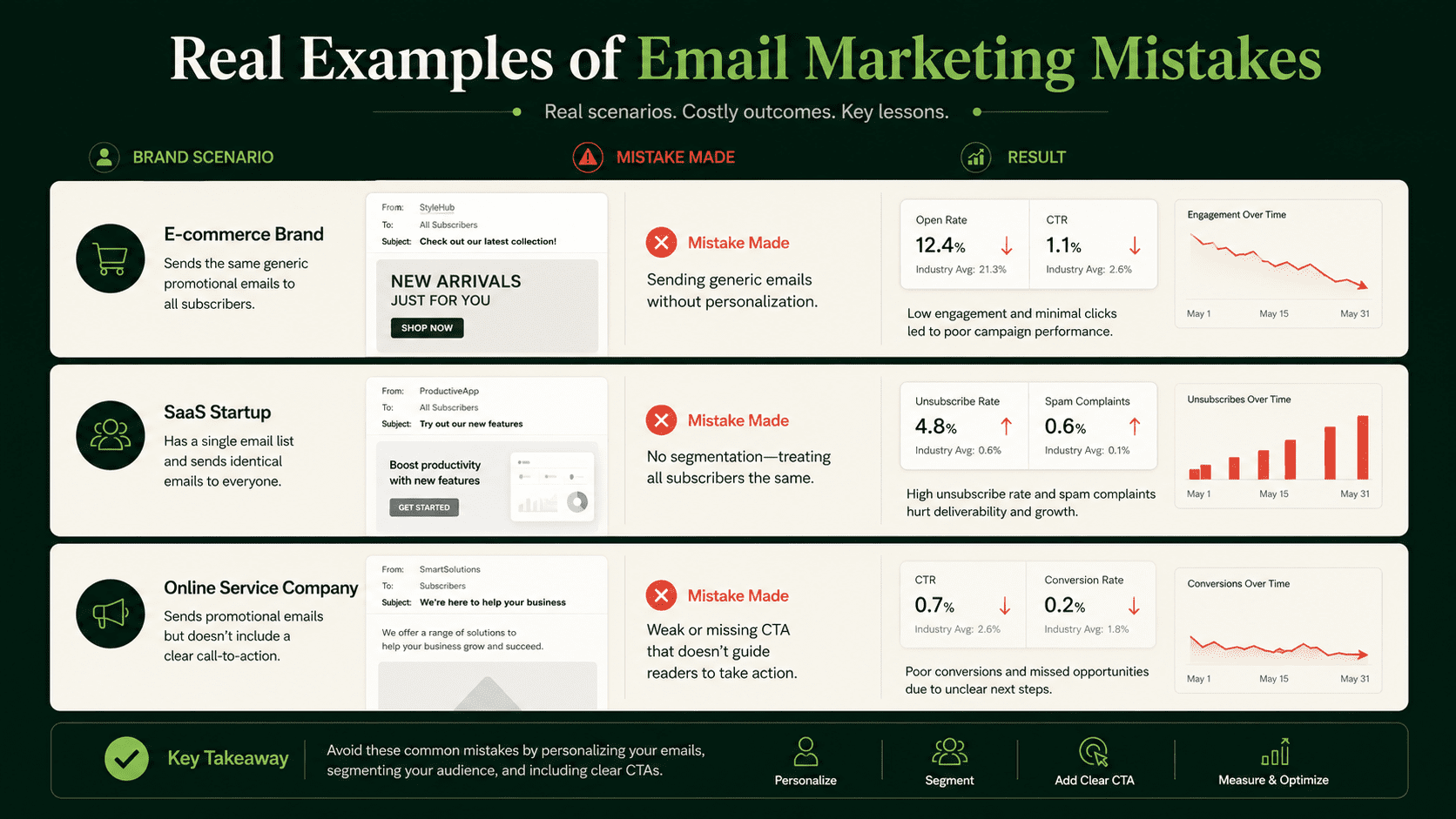
It’s like handing out the same flyer to everyone on a busy street corner. Sending the same generic email to everyone on your list. It says to your subscriber, “I don’t really know you or don’t care to. In a world where consumers receive 120+ emails a day, generic messages are ignored, deleted, or marked as spam.
Why it kills conversions: Subscribers are far more likely to engage with content that speaks directly to their needs, interests, or name. Without personalization, you’re leaving open rates and click-through rates on the table.
Real-life scenario: An e-commerce store sends “Hey Customer, check out our latest products!” to 50,000 subscribers. Meanwhile, a competitor sends, “Hey Sarah, based on your last purchase, we thought you’d love these.” The personalized email gets 3× the clicks.
The fix:
- Use merge tags to insert first names in subject lines and body copy
- Reference past purchases, browsing behavior, or location
- Use dynamic content blocks that change based on subscriber segments
- Start with small personalization wins—even just using a first name can lift open rates by 26%.
Personalization isn’t just a nice-to-have—it’s the foundation of a results-driven email marketing approach. If you treat your email lists as a one-size-fits-all broadcast channel, you’re basically throwing away all the hard work you put into establishing them. The biggest email marketing mistakes are typically not technological—they are relational. Subscribers subscribed expecting communications that were relevant and personalized to them. The instant you undermine that expectation with a generic blast, you open yourself up to subscriber attrition, higher unsubscribe rates, and decreased sender credibility. Respect every name on your list as a real person with particular demands, and your email engagement rate will prove it.
Pro tip: Go beyond the first name. Tools like Klaviyo, Mailchimp, and Active Campaign allow deep behavioral personalization based on what subscribers click, buy, or ignore
More than 81% of people check email on a mobile device. If your email looks broken, tiny, or cluttered on a smartphone screen, your subscriber will close it within seconds and possibly may never open another one from you again.
Why it kills conversions: A non-mobile-friendly email creates a terrible user experience. Buttons too small to tap, images that don’t load, and text that requires zooming in all signal unprofessionalism and destroy trust.
Real-life scenario: A fitness brand launches a flash sale email with a large banner image and tiny CTA buttons. On desktop it looks great. On mobile, the image breaks and the “Shop Now” button is nearly invisible. Result: 70% of recipients (mobile users) bounce without clicking.
The fix:
- Use responsive email templates that adapt to all screen sizes
- Keep your email width between 600 and 640 px.
- Use large, tappable CTA buttons (minimum 44×44 px).
- Use single-column layouts for mobile clarity
- Always preview your email on both desktop and mobile before sending
Skip mobile optimization, one of those email marketing blunders that quietly bleeds your conversion rate with every single send. A good email marketing strategy always considers where subscribers are actually reading—and today, it’s predominantly on a smartphone. Poor mobile optimization might potentially negatively impact your email deliverability outside the user experience. When mobile consumers delete your emails without opening them or report them as spam out of frustration, inbox providers like Gmail and Outlook perceive such signals as markers of low-quality content—and start diverting your campaigns to the rubbish bin. But a responsive email design is more than just a pretty face. It’s a critical piece in protecting your sender reputation and maintaining a healthy inbox placement rate.
3. Writing weak subject lines
Your subject line is the gatekeeper of your entire campaign. It determines whether your email gets opened or ignored forever. A weak, vague, or boring subject line is the single fastest way to kill your email open rate before the campaign even starts.
Why it kills conversions: 47% of email recipients decide whether to open an email based on the subject line alone. If it doesn’t create curiosity, urgency, or clear value, it gets deleted.
Real-life scenario:
- Subject line A: “Our Monthly Newsletter” → 12% open rate.
- Subject line B: “You’re leaving money on the table, [Name]” → 34% open rate.
Same list. Same time. Completely different results.
The fix:
- Keep subject lines under 50 characters for mobile display
- Use numbers, questions, or power words (“Free,” “Urgent,” “Secret”)
- Create curiosity gaps: “You won’t believe what happened when we did this…” A/B test two subject lines every time you send
- Avoid spam trigger words: “Free!”, “Buy Now.” “Click Here”
One of the most significant markers of whether your email marketing strategy is actually connecting with your audience is subject line performance. Weak subject lines are toward the top of any list of frequent email marketing mistakes because the impact is immediate and measurable—a poor email open rate is obvious the moment your campaign dashboard loads. But the effect reaches beyond vanity metrics. Consistently poor open rates will convey bad signals to mailbox providers over time and affect your email deliverability. Good subject lines do more than get your emails opened. They get your emails seen by algorithms, keep your email lists healthy and active, and get your audience to participate. Think of your subject line as the one most crucial sentence in your entire campaign.
4. Over-emailing or spamming your list
Great excitement. What’s not okay is emailing your subscribers every single day. What’s not okay is emailing your subscribers every single day. What’s not okay is emailing your subscribers every single day. One of the most common email marketing mistakes is sending too often without providing enough value, and it silently destroys your list health and sender reputation.
Why it kills conversions: Subscribers who feel spammed will unsubscribe, mark you as spam (damaging your sender reputation), or simply tune you out. A damaged sender reputation means your emails land in the junk folder even for engaged subscribers.
Real-life scenario: A SaaS company sends daily promotional emails for two weeks straight. Unsubscribe rate jumps from 0.2% to 1.8%. Gmail starts routing their emails to the Promotions tab, reducing visibility by 60 percent.
The fix:
- Test your sweet spot for email frequency (most brands do well with 1-3 emails per week)
- Preference Center allows subscribers to set their own email preferences
- Monitor unsubscribe and complaint rates closely
- Follow a content calendar: mix promotional, educational, and nurturing emails.
Email frequency is one of the most underrated aspects in any email marketing strategy, and getting it wrong is one of the most expensive email marketing mistakes a firm can make. Not only are you aggravating your subscribers when you over-send, but you’re actively hurting your email deliverability.
5. No clear call-to-action (CTA)
You’ve written a beautiful email. You’ve told a compelling story. And then… nothing. No clear direction on what the reader should do next. A missing or weak CTA is one of the most conversion-killing email mistakes you can make.
Why it kills conversions: People need to be told what to do. Without a clear, compelling CTA, readers consume your email passively and move on. Your email becomes content instead of a conversion tool.
Real-life example: A coaching business sends a beautiful case study email but ends with, ‘Hope you enjoyed reading!’—no button, no link, no request. Clicks: 3. The same email, with a clear CTA button “Book your free strategy call,” gets 47 clicks.
The fix:
- One CTA per email (one goal, one action). One CTA per email (one goal, one action).
- Use action-oriented language: “Get Your Free Guide,” “Start My Trial,” “Claim My Discount.”
- Make your CTA button stand out—contrasting color, readable font,
- If it’s a longer email, include your CTA in both the middle and the end
Pro tip: Research shows that emails with a single CTA can increase clicks by 371% and sales by 1617% compared to emails with multiple competing links.
6. Poor email design
Your email design is your brand’s first impression in the inbox. A messy, badly formatted, or visually overwhelming email screams amateur hour and makes people distrust the content before they’ve read a single word.
Why it kills conversions: Humans process visuals 60,000× faster than text. A bad design derails the reader’s eye, buries your message, and reduces the credibility of your offer—directly tanking click-through rates.
Real-life situation: A travel agency email with 5 different fonts, 8 images, and no visual hierarchy. They scan it for 3 seconds, and they leave. A revamp – one hero image, a clear headline, a clean layout and one CTA – doubles their click-through rate.
The fix:
- Use a clean, white-space-friendly template.
- Stick to 1–2 fonts max and your brand colors.
- Use images purposefully, not decoratively.
- Ensure that the ratio of text to image is at least 60:40; otherwise, you will end up in spam filters.
- Use hierarchy: headline, subheadline, body, CTA. Error
7. Not segmenting your email list
Not segmenting your email list One of the biggest missed opportunities in email marketing is blasting the same email to your entire list, regardless of where each subscriber is on the customer journey. Different messaging for a new lead and a loyal customer.
Why it kills conversions: Segmented email campaigns generate 760% more revenue than non-segmented campaigns (Campaign Monitor). Sending irrelevant content erodes trust and increases unsubscribes.
Real-life scenario: An online retailer sends a “Welcome back, we missed you!” re-engagement campaign to their entire list, including customers who bought 2 days ago. They confuse and spam those recent buyers. Their complaint rates explode.
The fix segment is
- purchase history, engagement level, location, interests, signup source
- Create separate welcome sequences, nurture flows, and win-back campaigns
- Tag subscribers based on behavior (clicked X, bought Y, visited Z page)
- Use automation to trigger emails based on subscriber actions
8. Ignoring email analytics
If you’re not looking at your email metrics after every campaign, you’re flying blind. If you ignore analytics, you’ll keep making the same mistakes forever—you’ll never know why your campaigns aren’t converting.
Why it kills conversions: Without data, you can’t identify what’s working, what’s failing, or what to improve. You’ll waste budget on broken strategies and miss opportunities to double down on what converts.
Real-life example: A digital product creator runs 12 campaigns in 3 months. Never checks metrics. Later, a marketing audit reveals that one email had an open rate of 48% and a CTR of 15%. Had they seen it, they could have replicated the formula and tripled the revenue off that list.
The fix:
- Track these core metrics after every send: open rate, click-through rate (CTR), conversion rate, unsubscribe rate, bounce rate
- Industry benchmark: target 20%+ open rate and 2-3%+ CTR Track in Google Analytics by setting up UTM parameters in all email links
- Review performance weekly, not just m
Pro Tip: Most ESPs (Mailchimp, Klaviyo, ConvertKit, etc.) have built-in dashboards. Make decisions from data with a weekly 30 minute review of your email analytics.
9. Buying email lists
Buying email lists might feel like a shortcut to reach thousands of people overnight. In reality, it’s one of the fastest ways to destroy your sender reputation, violate GDPR/CAN-SPAM laws, and get your domain blacklisted.
Why it kills conversions: The contacts you bought never consented to receive your messages. They know nothing about your brand, they haven’t asked for your emails and a lot of those addresses are spam traps. Sending to them means sky-high bounce rates and spam complaints, signals that destroy your deliverability for your entire list.
Legal warning: If you send an email to contacts without explicit consent, you risk a fine of up to €20 million or 4% of your annual global turnover under GDPR (Europe) and CAN-SPAM (USA). Not worth it.
The fix:
- Build your list organically with lead magnets, gated content, and sign-up forms.
- Use content upgrades on high-traffic blog posts.
- Run paid traffic campaigns to opt-in landing pages.
- Partner with complementary brands for co-marketing lis
10. Not A/B testing your emails
Guessing what works in email marketing is a losing game. The brands that consistently win in the inbox are the ones running systematic A/B tests — constantly learning, iterating, and improving every element of their campaigns.
Why it kills conversions: Without testing, you won’t know if a different subject line, color of your CTA, send time, or body copy could have doubled your results. You are missing out on conversion rate optimization.
Example from the real world:
An online course creator A/B tests two subject lines:
A) “Join 10,000 students for our #1 best-selling course.” vs.
B) “This skill pays for itself in 30 days.”
Version B beats A’s 61% open rate lift – and that becomes their permanent subject line formula.
The fix:
- Test one variable at a time: subject line, send time, CTA, design, or sender name.
- Split your list 50/50 and send it to a test group before the full send.
- Wait for statistical significance (min. 100 opens per variation).
- Record all test results and create a “what works” playbook
Pro tip: The tiniest A/B test habit, testing one element per month, compounds into huge conversion gains in a year. Take every email as a chance to learn. The money’s on the list — but only if you play it right. Email marketing is most effective when it’s personal, relevant, and based on trust. – Neil Patel, Co-founder, NP Digital
Conclusion
Stop making these mistakes and start seeing results. Email marketing is not dead. Not even in the ballpark. But it takes intentionality, strategy, and a commitment to ongoing improvement. The 10 mistakes covered in this guide — from bad subject lines and missing CTAs to purchased lists and ignored analytics — can be fixed today. You don’t need a big budget or a team of experts. “You need clarity on what you’re doing wrong, a plan to fix it, and discipline to test and iterate. As a business, your email list is one of the most valuable assets you own. Give it the respect it deserves, and it will reward you with consistent compounding growth. Start with one correction.
Struggling with low open rates or poor conversions? Ready to transform your email marketing results? Start by auditing your last campaign. One improvement at a time — that's how elite email marketers are built. Start my email audit.
Let NexuraSight transform your email marketing into a high-performing growth engine.
Claim your FREE personalized audit and start seeing real results.
Boost Your Email Performance Today with NexuraSight
Written by: Zaina Nawaz
Lead Digital Strategist